
The structure of a Talmud page: a complete guide
A page of Talmud is not a page in a book; it is a working system, built over centuries of printing. Here is every zone of the folio - what it is, who wrote it, when it was added, why it sits where it sits and how to use it - mapped on a page you can click, and demonstrated on the real text of Berakhot 2a.
The map of the page
Select any zone to read its explanation. Every field of the folio is here, from the central text to the apparatus in the margins.
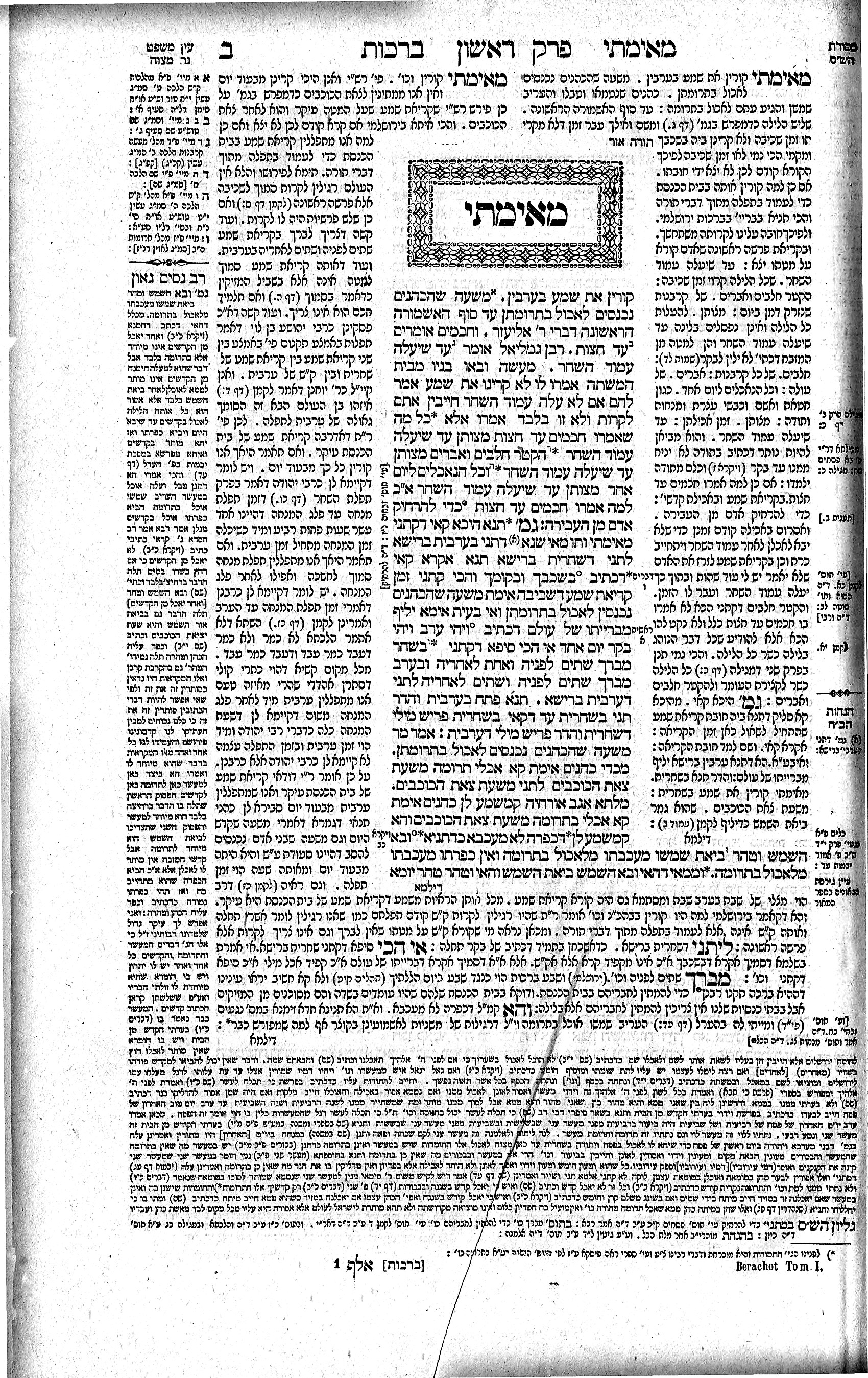
Berakhot 2a · 2/9
The Gemara (and Mishnah)
The central column: the opening Mishnah "מאימתי קורין את שמע בערבין" inside an ornamental frame, followed by the Gemara.
- What it is
- The central column. It carries the Mishnah - terse legal Hebrew - followed immediately by the Gemara: the Amoraic give-and-take on it, in Babylonian Aramaic.
- Who wrote it
- The Mishnah was edited by Rabbi Yehudah HaNasi; the Gemara records the discussions of the Amoraim of Babylonia.
- When
- The Mishnah at the close of the Tannaitic period; the Babylonian Talmud at the close of the Amoraic period.
- Why here
- This is the text itself. Everything else on the page is an aid to reading it.
- How to use it
- Always read the central column first, to the end of the passage, and only then turn to the sides. Printings mark the openings with "מתני׳" and "גמ׳".
Vilna printing · Internet Archive (Duke University Libraries) · Public Domain · source scan
The same page, in real text
These are the opening lines of Berakhot 2a as stored on this site, with the commentaries printed beside it. The full folio, with layout, glosses and text sizing, is one click away.
The Gemara
מתני׳ מאימתי קורין את שמע בערבין. משעה שהכהנים נכנסים לאכול בתרומתן עד סוף האשמורה הראשונה דברי רבי אליעזר. וחכמים אומרים עד חצות. רבן גמליאל אומר עד שיעלה עמוד השחר. מעשה ובאו בניו מבית המשתה אמרו לו לא קרינו את שמע אמר להם אם לא עלה עמוד השחר חייבין אתם לקרות ולא זו בלבד אמרו אלא כל מה שאמרו חכמים עד …
Rashi's column
מאימתי קורין את שמע בערבין - משעה שהכהנים נכנסים לאכול בתרומתן – כהנים שנטמאו וטבלו והעריב שמשן והגיע עתם לאכול בתרומה:
Tosafot
מאימתי קורין וכו' - פי' רש"י ואנן היכי קרינן מבעוד יום ואין אנו ממתינין לצאת הכוכבים כדמפרש בגמרא על כן פירש רש"י שקריאת שמע שעל המטה עיקר והוא לאחר צאת הכוכבים. והכי איתא בירושלמי אם קרא קודם לכן לא יצא ואם כן למה אנו …
Also stored for this folio side
Rav Nissim Gaon · Rashba · Ritva · Meiri · Maharsha (Chidushei Halachot) · Shita Mekubetzet · Penei Yehoshua · Gilyon HaShas · Chiddushei Rabbi Akiva Eiger · Ben Yehoyada · Rabbeinu Yonah · Tosafot HaRosh · Chiddushei HaRa'ah · Tziyyun LeNefesh Chayyah · Rashash · Rif
Edition: Wikisource Talmud Bavli · CC-BY-SA
Chapter 1
Folio, side, and one address for everyone
Every Talmudic citation is a tractate, a folio number and a side letter - not a chapter or an ordinary page number.
In an ordinary book, a page number belongs to an edition: change the typeface and the number moves. The Talmud works differently. "Berakhot 2a" sends every student in the world to the same line, whatever volume is on the table.
One folio holds two sides: amud alef and amud bet, the front and back of the same printed leaf. So "two folios" of Talmud are four sides of reading - which is why a daf yomi is two sides a day, not one.
The practical upshot for a new reader: there is no point looking for "page 40". The address is tractate, folio, side - and after that, if needed, the chapter name.
Chapter 2
Where the fixed numbering came from
The numbering is not as old as the Talmud: it was born in print, and it stuck because the whole world studied from the same edition.
The familiar page form - the Talmud in the centre with Rashi and Tosafot on either side - took shape in the earliest Hebrew printings and became the standard template with the first complete Talmud, printed in Venice in 1520–1523 at Daniel Bomberg's press. From that edition onward the folio numbering has been preserved in almost every printing.
The edition most students hold today is the Vilna Shas, printed by the Widow and Brothers Romm. It added commentaries and apparatus but did not change the numbering - which is why a citation from a centuries-old printing is still exact in a new volume.
Know the limit too: the numbering is a printer's convention, not a division from the Talmud itself. A passage can be cut across a folio break, and a chapter of the Mishnah can begin a third of the way down a side.
Chapter 3
Why every tractate begins at folio 2
There is no folio 1. This is not an error and nothing is missing.
The first leaf of each volume is the tractate's title page, and the Talmud itself begins on folio 2, side a. That is why "the start of the tractate" is always 2a, and why a citation of "folio 1" is not in use.
You can see this in our folio rail: the tractate opens at 2 and continues from there, two sides per folio, to the end.
Chapter 4
Gapat: the three fields of the page
Gapat - Gemara, Rashi's commentary, Tosafot - is the skeleton of every printed folio.
In the centre: the Talmud itself. On one side Rashi's column, on the other Tosafot. On Berakhot 2a - the opening page of the Talmud - Rashi is printed to the right of the central text and Tosafot to its left.
The columns are not uniform blocks: they are divided into comments, each opening with a dibur hamatchil, the words being commented on, set in bold. That is the page's search mechanism - instead of footnote numbers, the word itself is the address.
The usual working order: Gemara to the end of the passage, Rashi on whatever stopped you, and only then Tosafot. Starting with Tosafot means working on difficulties in a passage you have not yet read.
Chapter 5
The margins: four systems of apparatus
The narrow columns in the margins are not decoration. Each answers a different question.
Masoret HaShas answers "where else is this said". Torah Or answers "which verse is this". Ein Mishpat Ner Mitzvah answers "what was ruled from here". Hagahot HaBach answers "is the wording in front of me intact". Gilyon HaShas adds a terse analytical note, usually a cross-reference that raises a difficulty.
The system did not appear at once: the reference apparatus was installed in the sixteenth-century Italian printings, and the textual and analytical notes were added in later generations. Different printings therefore differ in their margins.
For a beginner: there is no need to read the margins straight through. They open in answer to a question - and when there is no question, they stay closed.
Chapter 6
Rashi script, and the abbreviations your eye must learn
Two technical barriers stop new readers: the letterforms in the commentary columns, and the abbreviations.
The Rashi and Tosafot columns are set in "Rashi script" - a printing typeface with no connection to Rashi's own handwriting, chosen in print to distinguish commentary from the central text. Twenty minutes of getting used to the letters kuf, tet, alef, tzadi and mem is usually enough to read fluently.
The abbreviations are a habit of printing, not a linguistic difficulty: "מתני׳" for Mishnah, "גמ׳" for Gemara, "ד״ה" for the dibur hamatchil, "וכו׳" for the continuation that was not printed. They recur on every page, so learning them pays off at once.
On this site the commentaries can also be displayed in ordinary letters, and word glosses can be switched on above the words themselves - so a technical barrier is not mistaken for a conceptual one.
Chapter 7
Orienting yourself on a new page in sixty seconds
A fixed sequence you can repeat on any folio.
Read the header: tractate, chapter, folio, side - now you know where you are. Find the central text and spot the "מתני׳" and "גמ׳" markers, so you know what is Mishnah and what is discussion of it.
Look at the two side columns and identify which is Rashi and which is Tosafot. Run your eye along the margins to see which apparatus is active on this page - cross-references, verses, halakhah, textual notes.
Read one whole passage in the central text without stopping, marking with your eye where a question was asked and where an answer was given. Only then go back to Rashi, and after him to Tosafot. The first reading is for mapping, not for understanding everything.
Questions readers ask
- Why does every edition share the same folio numbers?
- Because the numbering was fixed in the earliest printings - above all the complete Talmud printed in Venice in 1520–1523 - and every later printing preserved it, including the Vilna Shas in use today.
- What do "a" and "b" mean?
- Amud alef and amud bet: the two sides of the same printed leaf. "Berakhot 2b" is the reverse side of the tractate's second folio.
- Is there no folio 1?
- Not in study use. The first leaf of the volume is the title page, and the Talmud begins on folio 2, side a.
- Rashi or Tosafot first?
- Rashi. He explains the passage itself; Tosafot raise difficulties on it. Opening Tosafot first means analysing a text you have not yet read.
- What is a dibur hamatchil?
- The opening words of the phrase a comment addresses, set in bold at the head of each comment in the Rashi and Tosafot columns. It is how you search the page: look for the words that stopped you.
- Is Rashi script Rashi's handwriting?
- No. It is a printing typeface chosen to distinguish the commentary columns from the central text, unrelated to his handwriting.
From the layout into a framework of study
The layout is the entrance, not the destination. These are the frames that turn a single folio into ongoing learning: the study sequence, the orders and tractates, the folio rail, and the method itself.
Where to go next
Reference works this guide draws on
- The Hebrew Wikipedia entries "צורת הדף", "גפ״ת" and "עין משפט נר מצוה"
- Vilna Edition Shas (English Wikipedia), on the Romm press
- Hadran's guides to the layout of a Talmud page and its symbols
- M. J. Heller, Designing the Talmud: The Origins of the Printed Talmudic Page